

Nobody Here Knows Who You Used to Be
On work, identity and being a Romanian in the Netherlands
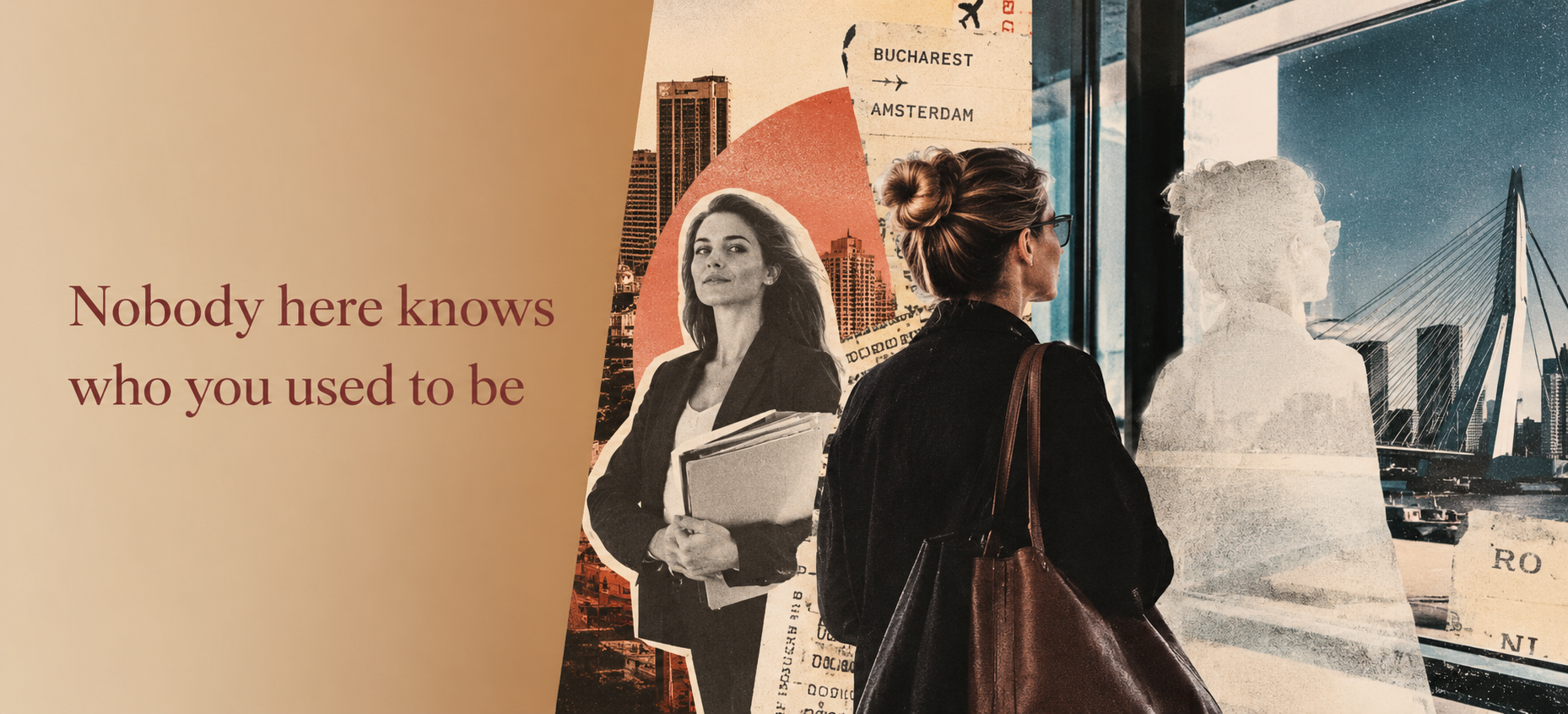
As a Romanian, I've run away as fast as I could from other Romanians in NL. And I checked with others, most of us do the same.
I grew up spending my summers in Italy. This might sound fancy but I assure you it's not, they weren't Call Me By Your Name Italian summers. I would join my mother at her workplace, which was the home of this lovely Italian woman named Gelsa, who was in my mother's care. There was a specific word for immigrant women who came to Italy to take care of older people for a living - badante.
Gelsa was kind enough to allow us to be together in her house during summer. In those days, my mom only had two free hours in the afternoon and I lived for those two hours. My mom is a very devoted worker, so she didn't take Sundays off like I knew other Romanian caretakers in Italy did. And in those two hours the most fun thing we'd do was visit clothing shops and go to Lidl. Not that fancy at all, is it?
It was in those times that I got the message that Romanians outside of Romania are not my people, because the ones in my mom's town would gather every afternoon in the parks, drink alcohol and not be astounding citizens of the countries that had adopted them. They'd get into arguments and fights and make it on the local news channels and I was a well-behaved schoolgirl, so other Romanians became “not safe.”
But in my first months in NL, back in 2017, I met a Romanian guy on the train and we've been good friends ever since. I've met Romanians at my workplace who've become my close friends and I meet Romanians almost weekly through my networking groups and communities. So, no wonder that my first coaching clients were, guess who, Romanian expats living in NL. Not only that our mother country binds us together, but boy are they my ideal clients! I wrote about my client archetypes here, but I wrote those as a copy for my website, as a pillar in my niching strategy. Yet they found me. My ideal client found me and is Romanian.
We, Romanian expats with an identity crisis, are a whole bunch. A big group here in NL. And today, I am writing to all of them.
We’ve built impressive careers in corporate Romania. We had our badges, titles, company cars, maybe even a small cabin in the mountains. We moved here as an act of self-care. We came to do the same thing we did well in Romania, but it's suddenly not working anymore. Because, and this is something I am only bringing back to the surface now, transitioning to a new country even with a solid career back home is a massive identity crisis.
And I've written about mine here. But I kinda thought, ok, that was me. In corporate sales, I only worked with non-Romanians most of the years, Dutch and expats and they've all mirrored the version of life I was in at that time: the super-achievers, success, house, vacations in Bali, great life on paper, I'm at the top of the mountain but why do I cry at night kind of people. I wrote about these people here.
It's only dawning on me now that we, Romanian expats with an identity crisis, are a whole bunch. A big group here in NL. And today, I am writing to all of them.
You had a good job in Romania. Not a fine job, a good one. You had a title people recognized when you said it at a wedding. You had a team, or a portfolio, or a region and you had a manager who told you, in the way managers do when they actually mean it, that you were one of the good ones, an asset to the company. You knew where you stood. That is the part you don’t really see back home, that you knew where you stood and you did not realize this was a thing you had until you did not have it anymore.
Then you moved. For a partner, for a job, maybe because Romania started feeling like a room with the air slowly going out of it and you told yourself you were doing this for your health, for your future, for your children and all of that was true. You did not run away, you made a decision. You are a person who makes decisions.
And now you are here and you are doing the same thing you used to do and it’s not working.
Nobody has explicitly complained about you or your performance. Nobody has said anything bad, that is the confusing part. On paper, the move was a success. You have the apartment or you are working on it and you have the bank account and the DigiD and you have figured out where to buy the good pastries. From the outside, and especially from the outside as viewed by your mother & relatives on WhatsApp, you are doing extremely well.
But the version of you that worked back home, the one who could walk into a room and read it in eight seconds and know exactly which register to speak in, that person did not translate. She speaks a language now that is technically English but is not the English these people use. She makes a joke in a meeting and it lands somewhere on the floor between two Dutch colleagues who look at her kindly and move on.
The thing you were good at, the thing that made you you, was never just competence. It was competence + context. And you left the context.
So you do what we all do, which is to work harder. You take on new projects because of “the development opportunity.” You work around the clock. You do the course and then another course, because obviously the problem is that you are missing a skill and if you find the missing skill, everything will click back into place. You get very good at explaining, at parties, why you moved, in a way that sounds decided rather than survived. And you tell yourself you are adjusting, that everyone says the first two years are hard, that once the language comes, once the network comes, once the next role comes, you will feel better.
I did this for years. I kept looking for a professional solution because “I need another skill” was much easier to tolerate than “I don’t know who I am here.”
Back home, you knew you were okay because everything around you kept telling you: the job title, your colleagues, your parents' friends told you, in that specific Romanian way where the compliment is aimed slightly to the side of you so you do not get too full of yourself.
You didn’t have to explain why you were good. It was already understood.
But here, most of that context is gone. Nobody knows the company you used to work for. Nobody knows what your title meant. Your Dutch colleagues are polite and impossible to read. Your Dutch is good enough for Albert Heijn but not good enough to be funny in, which is a specific kind of loneliness I don’t think anyone has thought about before moving here.
So you stand here, in a country you chose, doing a job you are technically qualified for, wondering whether you are still as good as you thought you were.
And because you do not know, you start looking for someone to tell you. You look for it in the next job interview. You look for it in a recruiter's reply. You look for it in whether your husband thinks you have adjusted well, in whether your Dutch neighbour smiles back, in whether the client says yes. You start collecting small votes. And when the votes come in, you feel fine for about an afternoon and then you need more.
This is what happens when you outsource your sense of Okay to an external system and then move to a country where that system of support does not exist.
I know because I built my whole self on quarterly targets for twelve years and then I stopped and for a while I genuinely did not know how to tell whether a day had gone well. There was no number. Nobody was checking. I remember standing in my own kitchen thinking, with real panic, if nobody is measuring this, how do I know if I am doing it right?
That question is the whole thing. That question is why you are tired in a way sleep does not fix.
Us, Romanian, we are extraordinarily good at enduring. So we take it all on: the move, the job beneath us, the loneliness, the distance from our mothers, the guilt about that distance, the apartment back home that we bought and never lived in.
We carry all of it without really processing any of it. Then we wonder why we cannot enjoy the life we worked so hard to build.
You did not just move. You lost something of yourself and you have not been allowed to grieve it, because grieving it would mean admitting the move cost something and admitting the move cost something feels dangerously close to admitting it was a mistake.
It cost something, it was not a mistake. Both of those are true and until you let both of them be true at the same time, you will keep trying to fix your résumé when the problem is somewhere else entirely. So here is what I want to ask you and it is the only thing I am going to ask you in this article:
Are you still trying to prove that you are someone here?
Perhaps you are waiting for your manager to recognize what you can do or for a recruiter to choose you. For your family back home to confirm that leaving was worth it. For this country to “confirm” that you have adjusted successfully.
You only know that you keep working, achieving and collecting small confirmations and none of them settles the question for very long. This is useful information. This is also where my coaching begins. I work with professionals who are smart, capable, but no longer want their job, achievements or somebody else’s reaction to decide whether they are Okay.
If you are a Romanian professional living in the Netherlands and recognised yourself here, you can write to me. You do not need to arrive with a plan or know whether the problem is the job, the move or something else. “I think this might be about me” is good enough. 🤸
